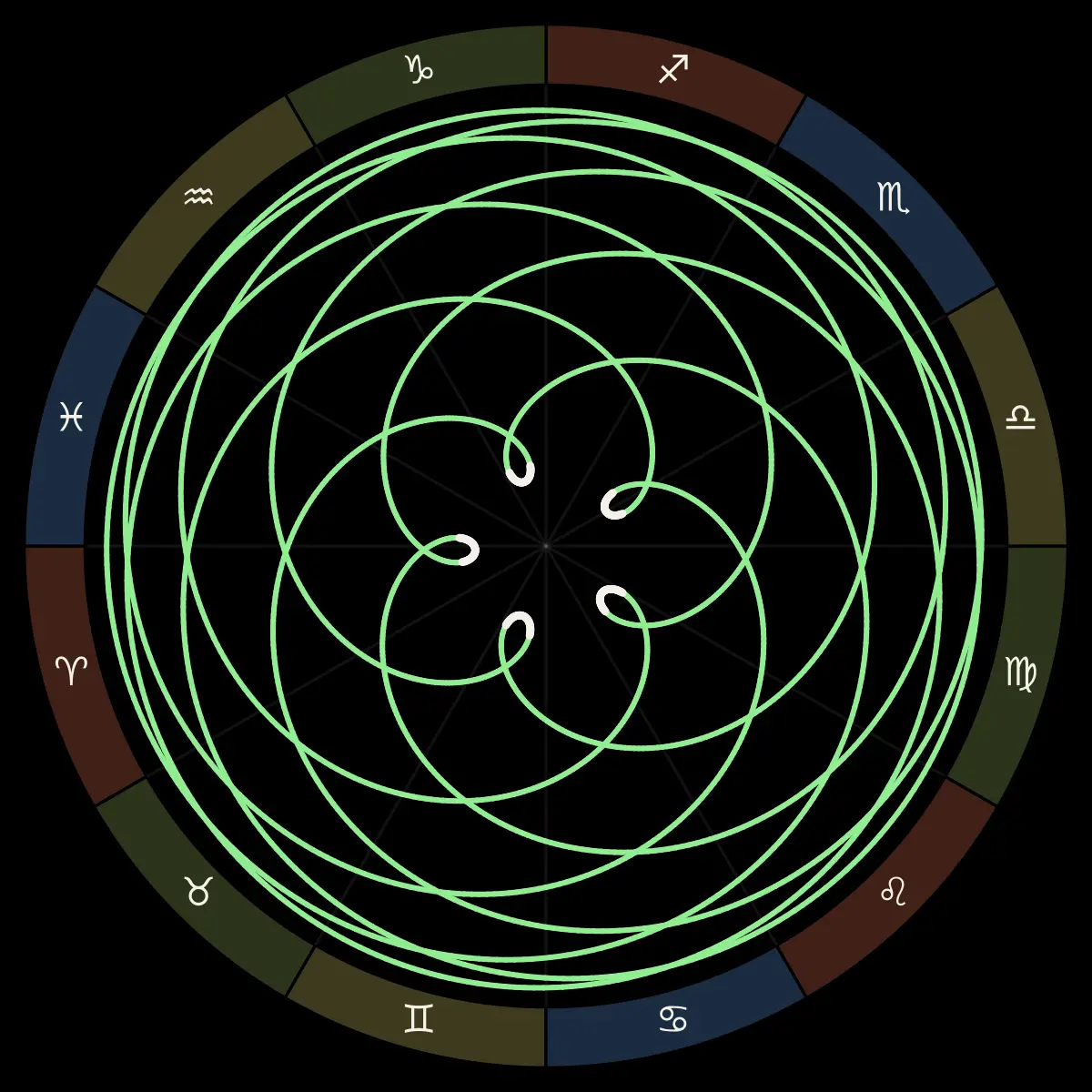
♀ Venus’s cycles
Venus comes back to the same place relative to the Sun every 584 days. For about 263 days it shines in the west after sunset as the evening star. Then it slows, stops and runs backwards for about six weeks—a retrograde—passing between the Earth and the Sun at the inferior conjunction and reappearing in the east before dawn as the morning star, for about 263 days more, before slipping behind the Sun to begin again. Five of these cycles take almost exactly eight years.
Why it runs backward
The retrograde is a trick of perspective—Venus, on its smaller, faster orbit, is passing between the Earth and the Sun and overtaking us. For those six weeks it seems to slide backwards against the stars.
The pentagram
Venus passes between the Earth and the Sun in the middle of each retrograde. If you plot those points over eight years, you get a five-pointed star.
Every eight years
| 2004 | ♊︎ 17° | ♑︎ 23° | ♌︎ 24° | ♈︎ 7° | ♏︎ 5° |
|---|---|---|---|---|---|
| 2012 | ♊︎ 15° | ♑︎ 21° | ♌︎ 22° | ♈︎ 4° | ♏︎ 3° |
| 2020 | ♊︎ 13° | ♑︎ 18° | ♌︎ 20° | ♈︎ 2° | ♏︎ 0° |
| 2028 | ♊︎ 11° | ♑︎ 16° | ♌︎ 18° | ♈︎ 0° | ♎︎ 28° |
| 2036 | ♊︎ 9° | ♑︎ 13° | ♌︎ 16° | ♓︎ 28° | ♎︎ 26° |
| 2044 | ♊︎ 7° | ♑︎ 11° | ♌︎ 13° | ♓︎ 25° | ♎︎ 23° |
Once a year
The eight-year cycle brings Venus to one of eight evenly spaced points around the Sun each Earth year. If you draw lines between those positions in order, you get an eight-pointed star. The eight-pointed star is a traditional symbol for Venus, going back to ancient Mesopotamia.
This diagram shows where Venus will be on November 9 in each of the next eight years, and the star those positions make.